
Book Appointment Now

Joint Replacement & Robotic Surgery
Joint replacement is one of the most reliable operations in orthopaedics, and one of the most personal decisions you will make. At Brain & Bone in Ghatkopar, we assess, plan and perform knee replacement, hip replacement and robotic-assisted joint replacement. The question is rarely whether the technology exists — it does — but whether it is the right operation, at the right time, for your knee or hip and your life. This page sets out how joint replacement is assessed, planned and performed at Brain & Bone, including robotic-assisted surgery.

OVERVIEW
Replacing the joint is only half the job. Restoring the life you had is the other half.
A joint replacement removes the damaged surfaces of a knee or hip and replaces them with implanted components, so that the joint can move without the bone-on-bone pain that comes with advanced arthritis. It does not make the joint young again, and it does not suit every patient. What it does do, in the right patient, is predictably reduce pain and restore walking, sleep and independence.
The decision is made over a consultation, not in one moment. We look at your symptoms, your X-rays, your general health and what you want to get back to — walking to the market, climbing stairs at home, returning to work, or playing with grandchildren. If you are still weighing up non-surgical options, our orthopaedic consultation and joint care service is the right starting point. For independent background reading, the AAOS guide to total knee replacement is thorough and jargon-light.
WHAT WE TREAT
Five ways we approach a worn joint.
From the first evaluation to a revision opinion, every step is planned around your joint and your life — not the implant catalogue.
01
Knee Replacement

Knee Replacement
What it is
Knee replacement resurfaces the worn ends of the thigh bone and shin bone, and the back of the kneecap where needed, with metal and plastic components. It is offered for advanced arthritis — usually after the cartilage has worn through — when pain limits walking, sleep and daily activity and has not responded to non-surgical care.
What we assess
Knee pain that persists at rest or at night; stiffness that limits walking distance and stairs; deformity such as bowing; X-rays showing joint-space loss; and a failure of physiotherapy, weight management or injections to control symptoms. Age alone is not the deciding factor — function and general health are.
What to expect
An examination and weight-bearing X-rays, followed by a discussion of what the operation involves, the expected recovery and the risks. Surgery is a planned admission, usually with a spinal anaesthetic, and most patients are walking with support within a day. Rehabilitation begins immediately and continues for weeks.
Hip Replacement
What it is
Hip replacement replaces the worn ball and socket with a prosthetic joint. Hip arthritis often shows itself as groin pain, stiffness putting on socks and shoes, and a shortening walking distance — sometimes with pain referred to the thigh or knee. The operation is highly effective when the joint is genuinely worn.
What we assess
Groin and buttock pain, stiffness and restricted rotation, night pain, a limp, and X-rays showing loss of joint space, cysts or deformity. We also check for causes of hip pain that are not arthritis, such as avascular necrosis or hip dysplasia, because they change the plan.
What to expect
Assessment, X-rays and a clear explanation of the approach, implant choice and recovery. Most patients stand and walk on the day of surgery and are discharged within a few days. Hip precautions and physiotherapy are explained before you leave, not after.
02
Hip Replacement

03
Robotic-Assisted
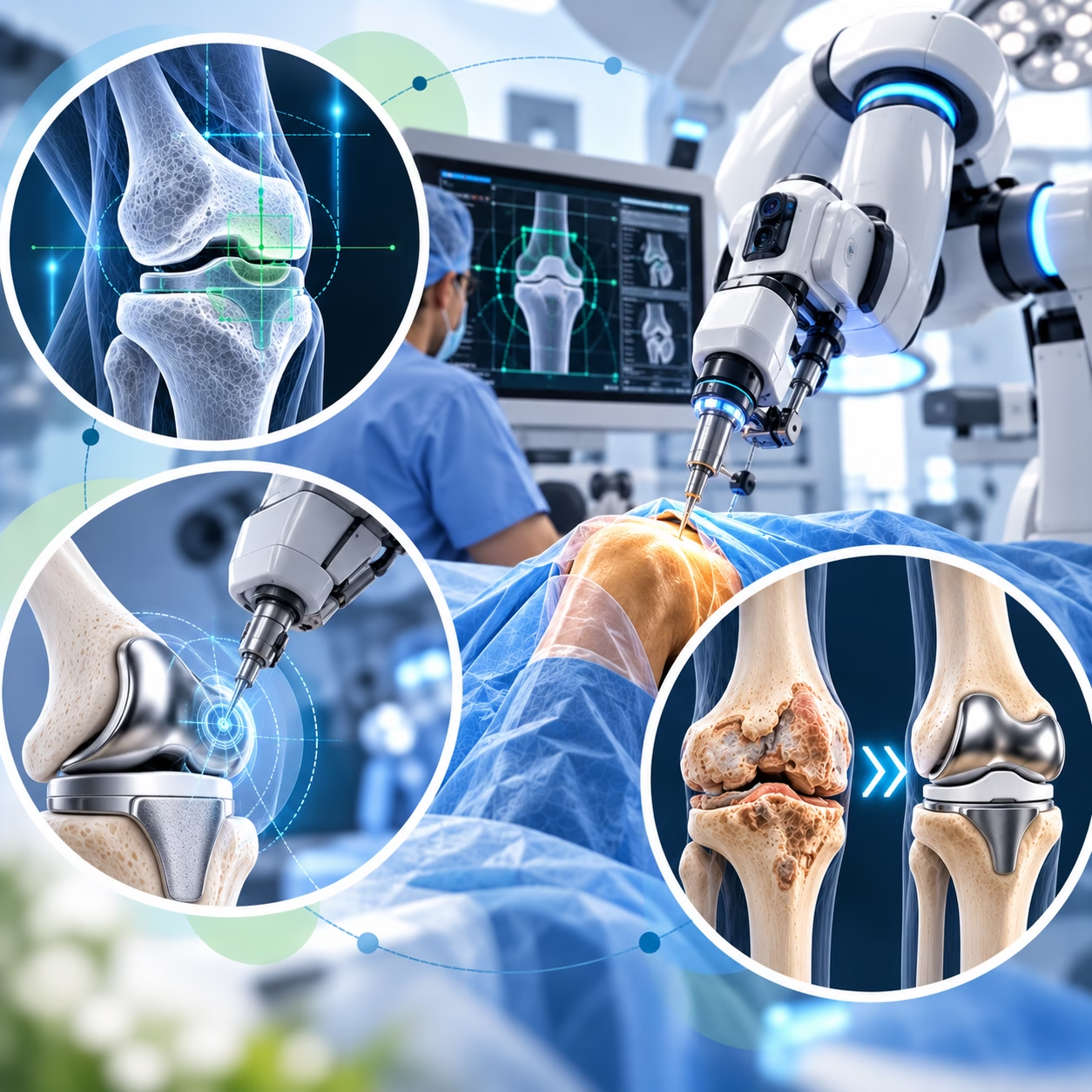
Robotic-Assisted Joint Replacement
What it is
Robotic-assisted joint replacement uses a robotic arm guided by a patient-specific plan, built from a CT scan of your own knee or hip, to help position the implant and prepare the bone with precision. It is the same operation as a conventional joint replacement — the difference is in the planning and the accuracy of execution.
What we assess
Suitability is assessed case by case. Robotic assistance is considered where precise alignment and balancing are particularly important — for example in deformity, in a previous fracture around the joint, or where soft-tissue balance is difficult to judge. It is not offered as a default.
What to expect
A CT scan and planning session before surgery, then the procedure with the robotic system assisting the surgeon. The implant, the hospital stay and the rehabilitation are the same as for conventional surgery. You will be told honestly whether robotic assistance is likely to add anything in your case.
Joint Replacement Evaluation
What it is
Not every painful joint needs replacing, and not everyone who needs a replacement is ready for one. Evaluation is the step that separates the two — a structured assessment of the joint, the person and the timing, before any decision is made.
What we assess
The severity and pattern of symptoms; how much they limit daily life; previous treatments and whether they were given a fair trial; X-ray findings; general health, medication and anaesthetic risk; and what you expect from surgery.
What to expect
A consultation that covers the diagnosis, the alternatives and, where surgery is appropriate, what it can and cannot deliver. You leave with a clear recommendation and the reasoning behind it. If the answer is to wait, you will be told that too, and what to watch for.
04
Evaluation

05
Revision Consultation
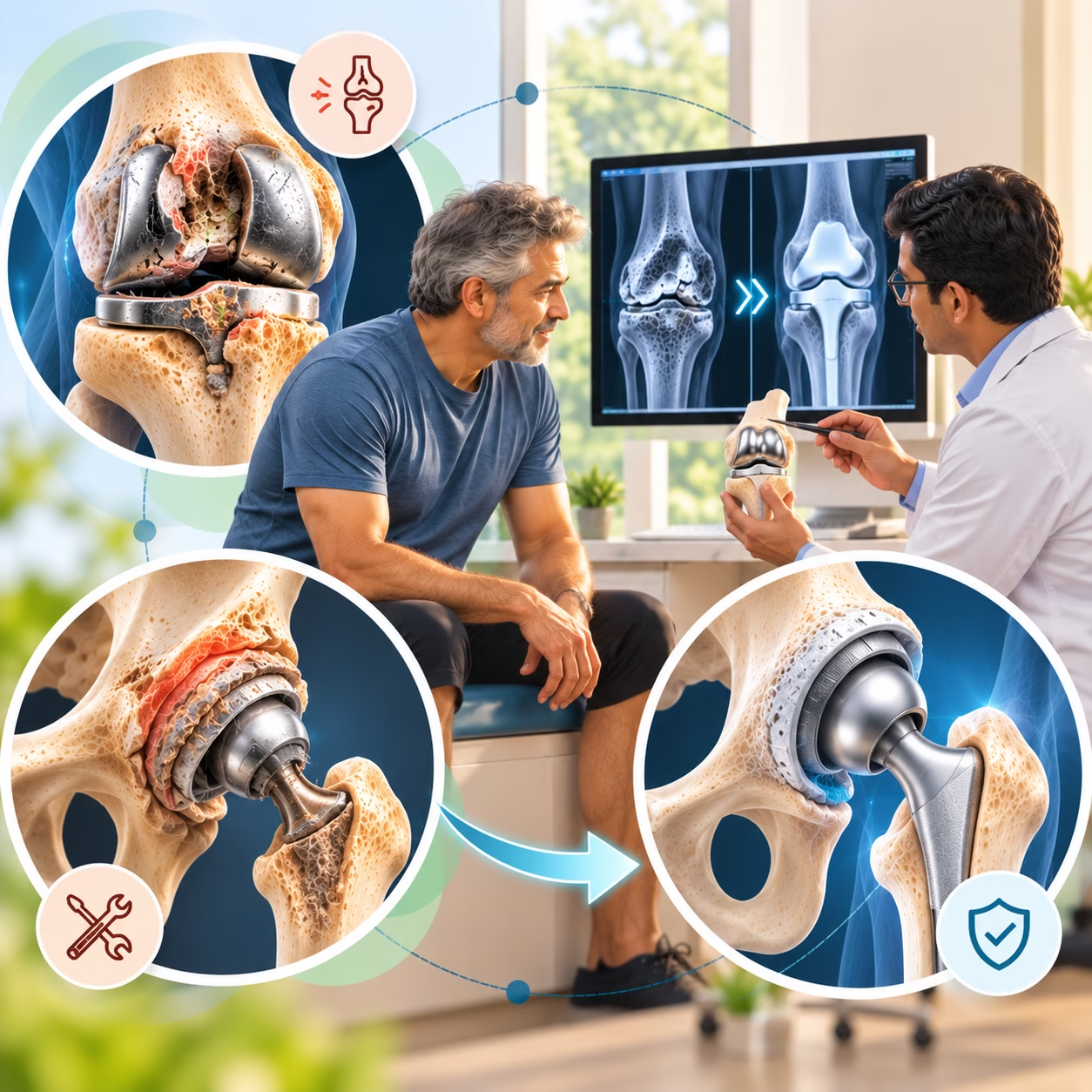
Revision Joint Replacement Consultation
What it is
A revision is a second operation on a joint that has already been replaced. It is needed when an implant loosens, wears, becomes infected, or when the joint is unstable or stiff. Revision surgery is more complex than the first operation, and the decision deserves a careful, unhurried assessment.
What we assess
Pain in a previously replaced joint; instability or a feeling that the joint gives way; stiffness; signs of infection; loosening or wear on X-ray; and the original operative records and implant details where available.
What to expect
A full review of the history, examination and imaging, including blood tests where infection is a concern. We explain what is likely wrong, what a revision would involve, and what the realistic outcome is. Where surgery is not the answer, that is said plainly.
THE PATH THROUGH SURGERY
Four stages, one plan.
The same sequence applies whether the operation is conventional or robotic-assisted. What changes is the precision of the plan, not the care around it.
01
Evaluate
History, examination and weight-bearing X-rays establish whether the joint is worn and whether surgery is the right next step.
02
Plan
Implant choice, alignment targets and, where appropriate, a CT-based robotic plan — agreed with you before the date is set.
03
Operate
A planned admission with a spinal anaesthetic, careful soft-tissue handling and, where indicated, robotic assistance for precision.
04
Recover
Physiotherapy from day one, a staged return to walking, driving and work, and follow-up until function is restored.
WHY BRAIN & BONE
Because you deserve to be treated as a person, not a diagnosis.
Specialist-Led Consultations
Every visit begins with the specialist who treats your condition.
Personalised Treatment
Plans built around your body, your mind and your life.
Evidence-Based Care
Treatment decisions grounded in clinical judgement, not guesswork.
Confidential Mental Healthcare
A private, respectful space for every conversation.
Clear Communication
Every option explained, in language you understand.
Continuity of Care
Follow-up and recovery support, not a single visit.
MEET YOUR SPECIALIST
Dr. Neeraj Mishra
Orthopaedic & Robotic Joint Replacement Surgeon

ABOUT YOUR DOCTOR
Treatment that starts with understanding the person.
I am an orthopaedic and robotic joint replacement surgeon with a focus on helping patients overcome pain, regain mobility and return to an active, independent life. Orthopaedic treatment, to me, is not simply about treating a bone or a joint — it is about restoring function and helping a person get back to the life they value.
My approach begins with understanding your symptoms, lifestyle and functional limitations, followed by a thorough clinical assessment. I explain the diagnosis and the treatment options clearly, so that you can make an informed decision about your own care. Where appropriate, I prefer to explore non-surgical options first.
With more than ten years of clinical experience, my work includes joint replacement and robotic-assisted joint replacement, with an emphasis on careful planning and appropriate patient selection.
FREQUENTLY ASKED QUESTIONS
Questions patients ask before booking.
When is joint replacement the right choice?
When joint pain from advanced arthritis limits walking, sleep or daily activities, and non-surgical treatment — activity modification, physiotherapy, medication or injections — has been given a fair trial without lasting relief. Age by itself is not the deciding factor; general health and functional goals matter more.
How long does a knee or hip replacement last?
Modern implants are expected to last 15 to 20 years or more in most patients, though longevity depends on activity level, weight, bone quality and implant type. Registry data suggests roughly nine in ten implants are still functioning at 15 years. Revision surgery is possible if an implant wears or loosens.
Is robotic-assisted surgery better than conventional surgery?
Robotic assistance improves precision in planning and bone preparation, and can help with alignment and soft-tissue balance in suitable patients. It has not been shown to be universally better than a well-performed conventional replacement, and it is not right for every case. It is used where it adds something specific.
How long will I stay in hospital?
Most patients stay two to four days after a knee replacement and two to three days after a hip replacement. You will usually stand and take a few steps with support on the day of surgery or the day after, and discharge is planned around safe walking and stairs.
How soon can I walk and drive again?
Walking with support begins immediately. Most people walk unaided indoors within two to four weeks and outdoors by six to eight weeks. Driving is usually possible at four to six weeks for the left leg, longer for the right, once you can brake safely and your surgeon has reviewed you.
Will I need physiotherapy after surgery?
Yes. Physiotherapy is part of the operation, not an optional extra. It starts in hospital and continues at home or at a clinic for several weeks. The aim is range of movement, strength and a confident gait, and the exercises matter as much as the surgery itself.
What are the risks of joint replacement?
All surgery carries risks. For joint replacement these include infection, blood clots, stiffness, instability, nerve or vessel injury, and, rarely, fracture around the implant. Most are uncommon, and the specific risks for your case are discussed at the consultation rather than left in a consent form.
Can both knees be replaced at once?
Sometimes, but not routinely. A single operation is easier to recover from and carries fewer risks. Staged replacements a few months apart are common and often preferable. The decision depends on your general health, home support and how much the second knee is limiting you.
What Our Patients Think
We are committed to improving the health of our patients and their feedback matters the most to us.


Wherever you’re starting from, we’re here to help you move forward.
Whether you are dealing with pain, recovering from an injury, navigating a difficult phase of life, or simply looking for someone to talk to — the first step is reaching out.